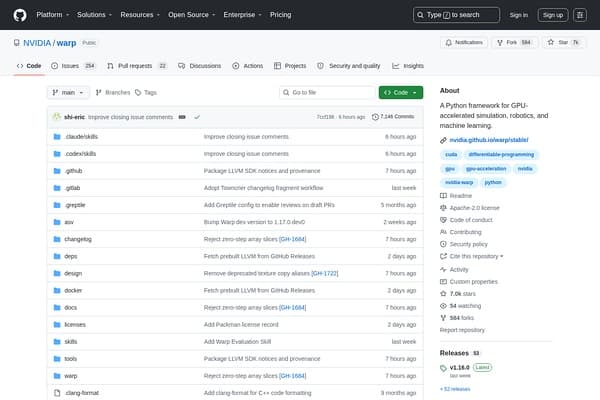
warp
Accelerate simulations & ML with Warp's powerful GPU framework.
AI Developer Tools·free
An open-source scheduler for workflow management that uses AI for optimizing task execution in data pipelines.
Apache Airflow is an open-source scheduler designed for managing complex workflows and data pipelines through a user-friendly interface and robust feature set. Utilizing Python, Airflow empowers users to develop, monitor, and execute workflows with ease and flexibility. Its architecture allows for dynamic task generation, enabling it to adapt to varying workload needs in real-time. As a powerful orchestration tool, Airflow is increasingly becoming the go-to solution for data engineers and scientists looking to streamline their data operations while integrating seamlessly with popular cloud providers and services.
Apache Airflow is free to use as it follows a freemium model. Users can contribute to the platform or opt for premium support services offered by third-party vendors.
Pros
Cons
Apache Airflow primarily uses Python for workflow definitions, allowing users to leverage Python libraries and features in their tasks.
Yes, Apache Airflow can be installed locally for development and testing purposes. It can also be deployed in cloud environments for production use.
While Airflow can manage scheduled workflows well, it is not inherently designed for real-time processing; however, it can still be integrated with real-time data streams.
Airflow provides a web UI where you can monitor tasks, view logs, and get insights into workflow execution and performance.
With Airflow, you can automate ETL processes, machine learning pipelines, data validation, and much more, making it highly versatile for various data operations.
Need to organize your AI tool files?
Managing files from Airflow and other tools? The Drive AI automatically organizes, tags, and retrieves all your files with AI.
Try The Drive AI free